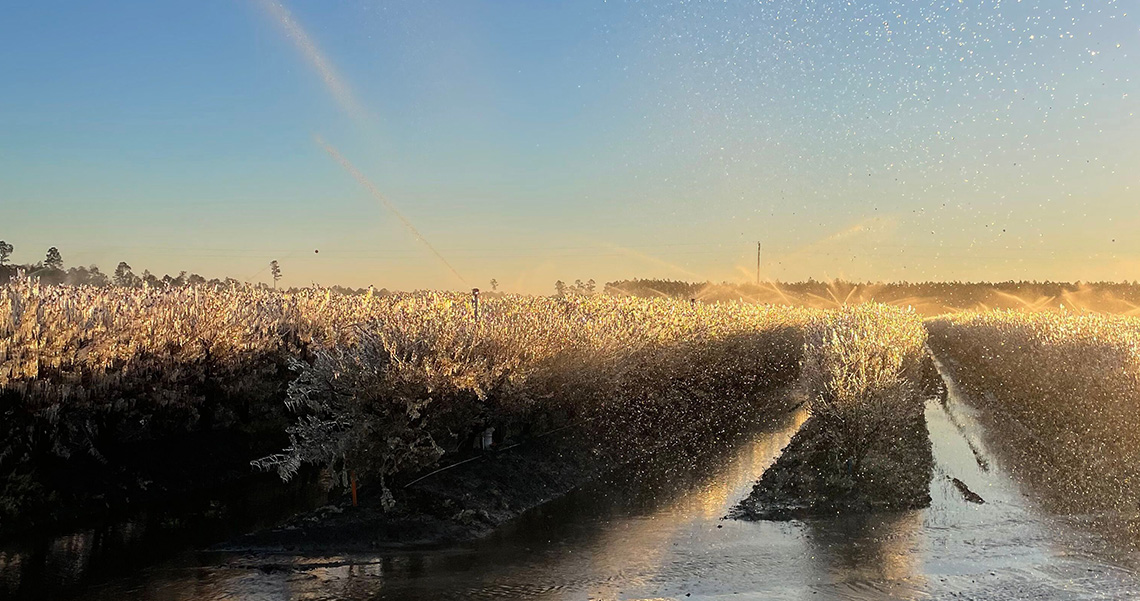
Do not wait until freezing temperatures are in the forecast to think about frost protection. A single cold event can damage blossoms, developing fruit, and plant tissue, putting crop quality and yield potential at risk. For berry and orchard growers, a properly designed frost protection system provides the preparation and dependable water coverage needed when temperatures fall.
TriEst Ag Group works with specialty crop growers to design permanent frost protection systems based on crop needs, field conditions, available water, and expected weather risks. From overhead sprinkler systems for berry crops to under-canopy Micro-Jet systems for orchards, careful planning can help growers protect their investment when cold weather arrives.
How Water Protects Plants from Frost
Water-based frost protection systems use the heat released when water freezes to help maintain plant tissue at approximately 32°F. As water changes from a liquid to ice, it releases a small amount of heat. This process helps prevent the temperature of the plant tissue beneath the ice from falling to more damaging levels.
For this protection to work, plants must receive a consistent supply of water throughout the freezing event. If water application stops too early, evaporation and continued cooling can lower plant temperatures and potentially increase damage. Water application generally continues until temperatures rise above freezing and the ice begins to melt naturally.
Overhead Frost Protection
Overhead sprinklers are commonly used for frost protection in berry crops and some orchard applications. Solid-set impact sprinklers and wobbler-style sprinklers distribute water over the crop canopy, blossoms, and developing fruit.
Because these systems may need to operate continuously for several hours, reliable water delivery is essential. The system must maintain the correct flow and pressure across the entire protected area. Uniform coverage helps ensure plants receive the consistent water application needed to support protection.
Overhead frost protection systems can provide several benefits:
- Reduced risk of cold injury to blossoms, fruit, and plant tissue
- More uniform water coverage across the protected area
- Permanent infrastructure that can be activated when cold conditions are forecast
- Greater readiness during critical crop development stages
- Potential protection of crop quality and yield
- Under-Canopy Micro-Jet Systems
Micro-Jets can also be installed beneath the canopy of orchard crops to help mitigate cold damage. These systems spray water beneath the trees, where the freezing process releases heat near the orchard floor and within the lower canopy environment.
Rather than coating blossoms or foliage directly, under-canopy systems help add heat to the orchard environment and may reduce temperature loss around the trees. Their effectiveness depends on orchard layout, canopy structure, weather conditions, and water application rate.
Micro-Jets can be incorporated into permanent orchard irrigation systems, giving growers a practical way to support both irrigation and frost protection needs.
Designing an Effective Frost Protection System
Frost protection is not a one-size-fits-all solution. Ambient temperature, wind speed, humidity, water application rate, crop type, field elevation, and system uniformity all influence how much protection can be achieved.
An effective system design should account for:
- Available water volume and water source capacity
- Required application rate for expected weather conditions
- Pump capacity and operating pressure
- Sprinkler or Micro-Jet type and spacing
- Field or orchard layout
- Zone size and control requirements
- Coverage uniformity across changing elevations
- Automation and monitoring options
Wind can carry water away from the target area and increase evaporative cooling, while an insufficient application rate may not release enough heat to protect the crop. Proper system design helps ensure water is applied consistently when it is needed most.
Start Planning Before Frost Season
A permanent frost protection system gives growers time to evaluate the water supply, test operating pressure, confirm coverage, and make adjustments before cold weather arrives.
Contact your local TriEst Ag Group location to begin designing a frost protection system that helps prepare your operation for the next freezing event.